Translate

Friday, 24 January 2014

A Beautiful Day In The Tropics

A recent trip to the Daintree Region north of Cairns was very pleasant. It is the height of summer in Australia and school children are just about to return to their studies and there are not many people about. For some, this is the best time to visit.
Miles of beach with not a soul around.
The water is warm, about 30C, but there are reasons to not enter. Stinging jellyfish are common this time of year and at least one species is fatal if encountered. And there are plenty of them about. Most public beaches have stations with bottles of vinegar to be used if you have the misfortune to be stung. Medical treatment is required if you do get stung.

But look carefully at the middle of the above photo. See anything?
Looks like a log, no? NO. It's Mr Croc cruising 50-100 metres offshore and heading to Cooper's Creek.

Buck Richardson photo

He's a biggie. We estimate more than 4 metres in length. Oh yes, that's another reason not to go into the water in the northern tropics of Australia.

Sunday, 12 January 2014

Photography Tricks

My colleagues alan Henderson and Piotr Naskrecki use a variety of techniques to enhance photos for various uses. One method they use is good for taxonomic studies has value in general education. I thought I might share it as I use it from time to time and it is incredibly simple and quick. And since everything is done quickly in this day in age, "quick" might be the operable word.

The equipment is simple and not costly.

Remember: click on the photo to enlarge it.

 A plastic dishwashing bin is all you need to get started. Just toss the insect in the bin. Usually it will sit still for a few seconds or minutes and you can get photos as it adjusts to this environment.


It is cicada season in Australia and there are at least a dozen species that come to the lights here and a few more that never do.

This tessaratomid comes around on ocassions. The flat surface of the body is ideally designed for this photgraphic technique.

It allows you to see some of the important characters on this female of Teleogryllus commodus.

So what's the trick?
Once the photo is taken, adjustments need to be made since the background will be uneven and have highlights, shadows and bits of dirt etc.
Imprints on the bottom of the plastic and highlights can be removed using a number of tricks. The contrast/brightness controls can be adjusted to reduce the highlights and shadows. In Photo Shop the "curves" function in the "adjustments" category can remove most of the problems seen above and the "Smudge" tool can be invoked to get rid of spots and dust that might cling to the specimen.
 Personal preferences dictate whether a shadow might be useful or not
Same photo with shadows eliminated using "curves" in Photo Shop. (By the way, this seems to be a "click beetle year". Every night several species come to the lights. Some of the tiny ones come in huge numbers.
Stalk-headed flies make their appearance in the wet season when there is plenty of fruit for them to eat. To reduce their tendency to fly, a few minutes in the fridge slows them down. I have left the shadows here as it seems to make the photo less clinical.

These are very weird flies with the eyes of the males on the end of stalk.

Raspy Crickets, family Gryllacrididae, are lovely creatures with wonderful colours and patterns that tend to disappear in dry-mounted specimens. This is an ideal way to illustrate these insects with a minimum of fuss. You can use "photo-stacking" for an even better photo but this takes time.
 This may be too "flat". Use of the contrast/brightness control can tame it a bit.
So how do you look at the more "private" parts of the insect that may help you to identify it or use in a taxonomic publication.

I kill the specimen in ammonium carbonate (the smelling salts of the boxing and cage-fighting pastime).  This leaves the specimen very pliable and you can manipulate it into a desired position. Above is the "before", below is the "after".


Below are a few more examples of the results of using this simple photographic technique.

Brentid weevils are very photogeneic and cooperative. The "bits" on the legs are parasitic mites.
 An meloid beetle in the genus Zonitis.
Monteith's LEaf Insect, Phyllium monteithi comes to the lights a few times each year. This is a male. Females have not been seen at my place in Kuranda.
Some cockroaches are more amenable to this form of photography. This adult female Calolampra species just sat in this position for several minutes while the photo was taken. Males would have flown off instantaneously.

This little cricket measures about 4 mm in length. It is a female as indicated by the protruding ovipositor. It lives on the rainforest floor in leaf litter. It colours and patterns can be appreciated using the photo techniques discussed above.

But some folks never cooperate. This live weevil remained in this position for 18 hours before we both gave up and I released him back into the rainforest.

So wat doya think?

Saturday, 28 December 2013

Silent Crickets


Most people are aware that crickets produce sounds. We normally hear the "calling song", that is the sounds produced to attract females. Crickets can produce other sounds announcing territoriality or post-mating sounds. It has been shown that the calling songs are highly species specific. That is females are “tuned” to answer the calls of males of their own species. Singing by romantic males of other species just go “over their heads”!

Females of some mole crickets, family Gryllotalpidae, can produce songs, thereby answering calling males but females of the typical crickets, family Gryllidae, are silent.

However, there are cricket species where neither sex produce any sounds at all. How and why this happens in evolutionary terms is often debated. Some of the ideas advanced include the obvious complexity of sounds in a particular kind of environment—perhaps, one with many cricket species or living in a odd place where sounds are not needed or desired e. g.—caves, for example where hungry bats may home in on a singing insect. In such a situation, males would be “selected” by the predator and this would put the population at risk. Being quiet may have its advantages.

How do silent crickets find one another? Perhaps, they find each other using chemical or visual signals.

Here in my rainforest I have discovered some 53 species of Gryllidae, give or take a few. Of this number some 35% are silent; they produce no sounds at all. Is this absence of sound production associated with living in the rainforest environment with the complexity of leaves, trees, shrubs, rocks etc. Maybe leaves, shrubs etc reverberate and interfere with the calling song. In such circumstances, maybe chemical signals get the sexes together. The population numbers of rainforest crickets that don't sing seems higher than one observes elsewhere, so calling by song may not be as important as it is where populations are dense. Cicada species seem to solve this problem by singing different times of the day and evening and singing during different seasons. 

Here is a list of the non-singing species recorded at my site

F=Flightless, LW=long-winged, capable of flight. A few species have both long-winged and short-winged (flightless) morphs. Silvinella species live on the forest floor in leaf litter. Both sexes are wingless. Most of the other are active on leaf surfaces at night. Euscyrtus lives in deep grasses and seems more active during the day.
Aphonoides australis (Walker) LW
A. lowanna Otte & Alexander LW
A. weeronga Otte & Alexander or near LW
A. debilis (Chopard) LW
A. sp nov. 1 LW
A. sp. nov. 2 LW
Genus nr Riatina (stridulatory file?) LW
Euscyrtus hemelytrus (Haan) F, LW
Umbulgaria hillimunga Otte & Alexander LW
Silvinella warraninna Otte & Alexander F
Amusurgus noorundi Otte & Alexander F
A. hackeri (Chopard) LW
A. kanyakis Otte & Alexander LW
A. minmirri Otte & Alexander LW
A. tinka Otte & Alexander LW
Metioche vittaticollis (Stål) F & LW
Trigonidium bundilla Otte & Alexander F
Trigonidium ?australiana (Chopard) F
T. killawarra or near Otte & Alexander F
Some examples.
Gryllidae; Pteronemobiinae; Silvinella wirraninna female
Gryllidae; Trigonidiinae; Amusurgus mubboonis Otte and Alexander male


 Gryllidae: Trigonidiinae; Amusurgus tinka female

Gryllidae; Trigonidiinae; Amusurgus hackeri (Chopard) female

Gryllidae; Trigonidiinae; Trigonidium bundilla male
Note the absence of a stridulatory file on the right wing on this and the other males below.
Gryllidae; Eneopterinae; Podoscirtini; Aphonoides sp 1 male
Gryllidae; Eneopterinae; Podoscirtini; Aphonoides sp prob australis

Gryllidae; Eneopterinae; Podoscirtini; Aphonoides weeronga male

Gryllidae; Eneopterinae; Podoscirtini; Aphonoides lowanna male light morph
Gryllidae; Eneopterinae; Podoscirtini; Aphonoides lowanna male dark morph
Gryllidae; Eneopterinae; Podoscirtini; Euscyrtus hemelytrus male

Gryllidae; Eneopterinae; Podoscirtini; Euscyrtus hemelytrus female


Tuesday, 10 December 2013

The Peppermint Stick-insect

Tis the Season. So why not the Peppermint Stick-insect. It is unlike the traditional peppermint stick in that it is not red and white. Here is its story.

Click on the photos to enlarge
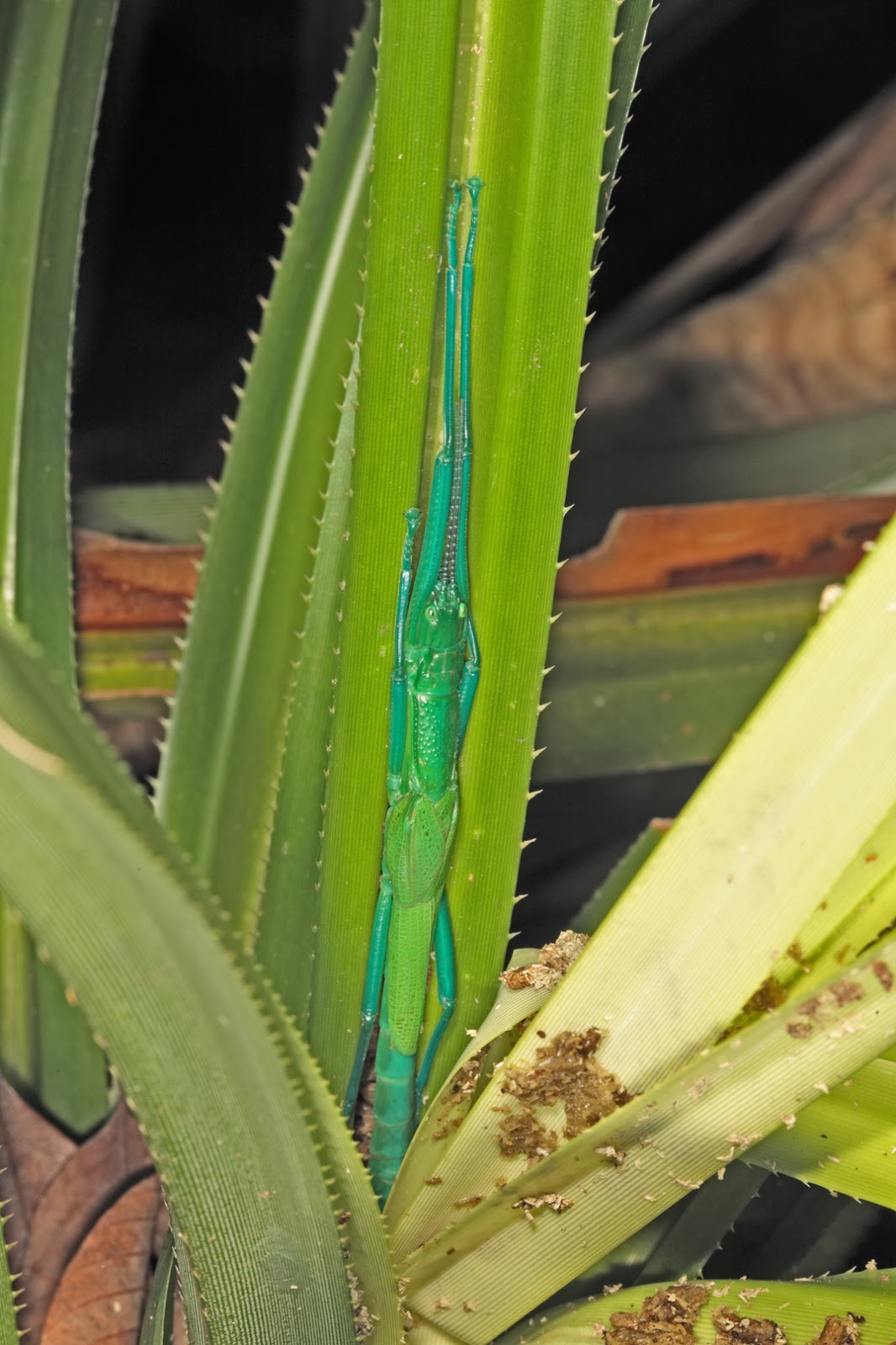
Typical resting position of a female Peppermint Stick in the mid-rib of Pandanus.

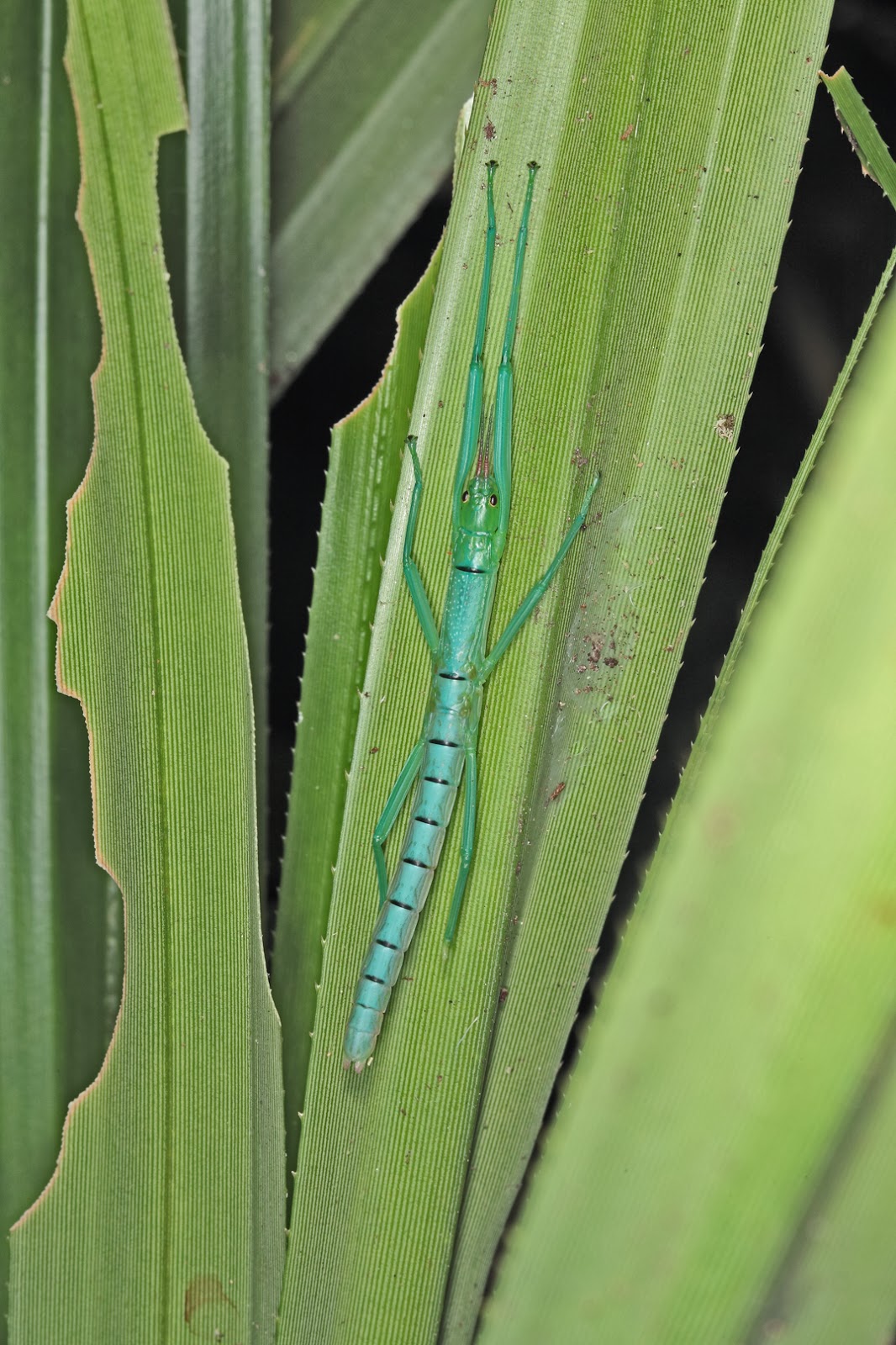
The Peppermint Stick-insect, Megacrania batesii (Kirby 1896) Phasmatidae; Platycraninae is one of the insect icons of the Daintree Rainforest region of far north coastal Queensland, Australia. Tourist operators know of at least two populations that provide impressive displays.
The fore and middle legs are forward with the antennae in between. Not the short forewings.

Although described over 100 years ago, these insects went unnoticed until relatively recently. My predecessor at CSIRO, Ken Key, showed me some ancient specimens in the collection from islands in the Gulf of Carpentaria but he said he had heard that the species was in the Daintree region in the far north. But nothing was known of its habits so it was with great excitement in the early '90's that I found a population in the Cape Tribulation area. I learned later that Jack Hasenpusch knew of a population at Etty Bay.
Resting in the heart of a spiny Pandanus. Note the feeding damage in the foreground. It would be a brave bird or lizard that would attempt to extract this individual.

This stick insect is associated with Pandanus. There are several species of Pandanus but this insect seems to prefer only one, P. tectarius. P. tectarius has a very broad distribution occurring along the the coast and inland for a considerable distance. So it was logical to assume that the sticks could be found elsewhere. But this is not the case. Diligent searching for many years of every Pandanus has failed to locate additional populations of the species. Where these insects occur they are numerous and the plants they live in have a distinct appearance. The leaves are chewed to the mid-rid in characteristic semicircular patterns.
"Paired up" The female is the larger individual on the bottom. This is a large insect, roughly the length of a pencil and slightly broader. Note that the pair is not mating. Males seem to "stake out" females and ride around on their backs. They are therefore available for mating whenever. Behaviourists would suggest that the male is therefore, protecting his offspring from being cuckold by other males. 
A pair of Peppermint Sticks. Note they are not attached.


The sticks have a rather simple biology. They never stray from their host plants even though they are winged and could probably fly or at least glide a bit. This species was described originally from the Solomon Islands and New Guinea and the Bismarck Archipelago. That may give some clue to the distribution of the stick.

The sticks live in the mid-rib of the Pandanus leaf. They scuttle back and forth and are highly perceptive of external activities. As soon as they detect the presence of danger, they retreat backwards into the base of the leaf protected from intruders by the spiny hooks along the sides of the leaves. They move using the fore and middle legs and use the hind legs only to move from one leaf to the other.

The droppings (frass) accumulates in the base of the leaves along with the many eggs females produce. During cyclones masses of Pandanus get dislodged and float out to sea. The sticks probably die during this time but the eggs may be safely carried to a new destination tucked in the axils of the leaves.
Frass accumulated inside at the base of the pandanus leaves. It is early in the season so there are few or no eggs there at this time.

An additional advantage to the stick is that it is probably facultatively parthenogenetic. That means that unmated females can lay eggs that hatch. In fact, it seems to be the case that the populations south of the Daintree region. Apparently no males have been found in these populations.
A late instar nymph, more blue than green.

A last instar female nymph. +Note the developing wing buds of the fore and hind wings. Also note the feeding damage to the plant.

Peppermint Sticks are diurnal. They have well developed eyes and are well aware of their surroundings. When suitably threatened, they squirt a white milky substance from the corners of the thorax at the intruders. The smell is reminiscent of peppermint. Hence the name!

A disturbed individual. The white spots are the points where the peppermint-smelling fluid is exuded as a spray. 

Seasons Greetings from the Peppermint Sticks and Bunyipco.

Wednesday, 20 November 2013

A Couple of Rainforest Pretties

Not all insects you see in rainforests are stunning but here are a couple that are really excetional.

 Zeuzera aeglospila (Turner) is a member of the family Cossidae. Cossid are called Carpenter Moths because the larvae live in dead wood, feeding and reducing the wood to phrass that provides nutrients to plants and other organisms. Z. aeglospila is a Queensland species but another member of the genus occurs in India and the Philippines feeds on Cinnamon trees and the genus Litsea. Nothing is known of the habits of the Australian species but we have Litsea on our property.

Many of the Carpenter Moths are grey or brown, not very colourful. But when you see this species up close it has a remarkable array of colours and iridescence.


Another gem is the Cuckoo Wasp. There are many species spread throughout the world. As a rule they are a challenge to the photographer because they seem like perpetual motion machines. You often see them examining holes in wooden buildings in search of potential hosts.

This little fellow flew into the house and landed on the window sill where it gradually came to rest.

Cuckoo Wasps (family Chrysididae) are usually under 20 mm in length and have a tough integument. The punctured sculpturing is a characteristic of the family and probably aids in preventing them from being stung. Most are parasites of other wasps ands when the tables are turned, they can roll up into a ball and become almost impervious to the stings of their hosts. A few species are parasites of moth larvae.