Translate

Showing posts with label Cassowary. Show all posts

Saturday, 14 December 2024

Now There Are Two

A couple of weeks ago Mr Cassowary showed up with only three of the four chicks he had this year. W(See below) We thought perhaps an accident or loose dogs had claimed the one chick. But now we are not so sure.
A few days ago we obsereved the male Cassowry chasing and biting one of the three chicks. There seemed to be nothing wrong with the chick. It was not injured or sick. He kept driving it away from the others. The startled chick stood off from the group hollering for help as chicks do when they are separated from their father.

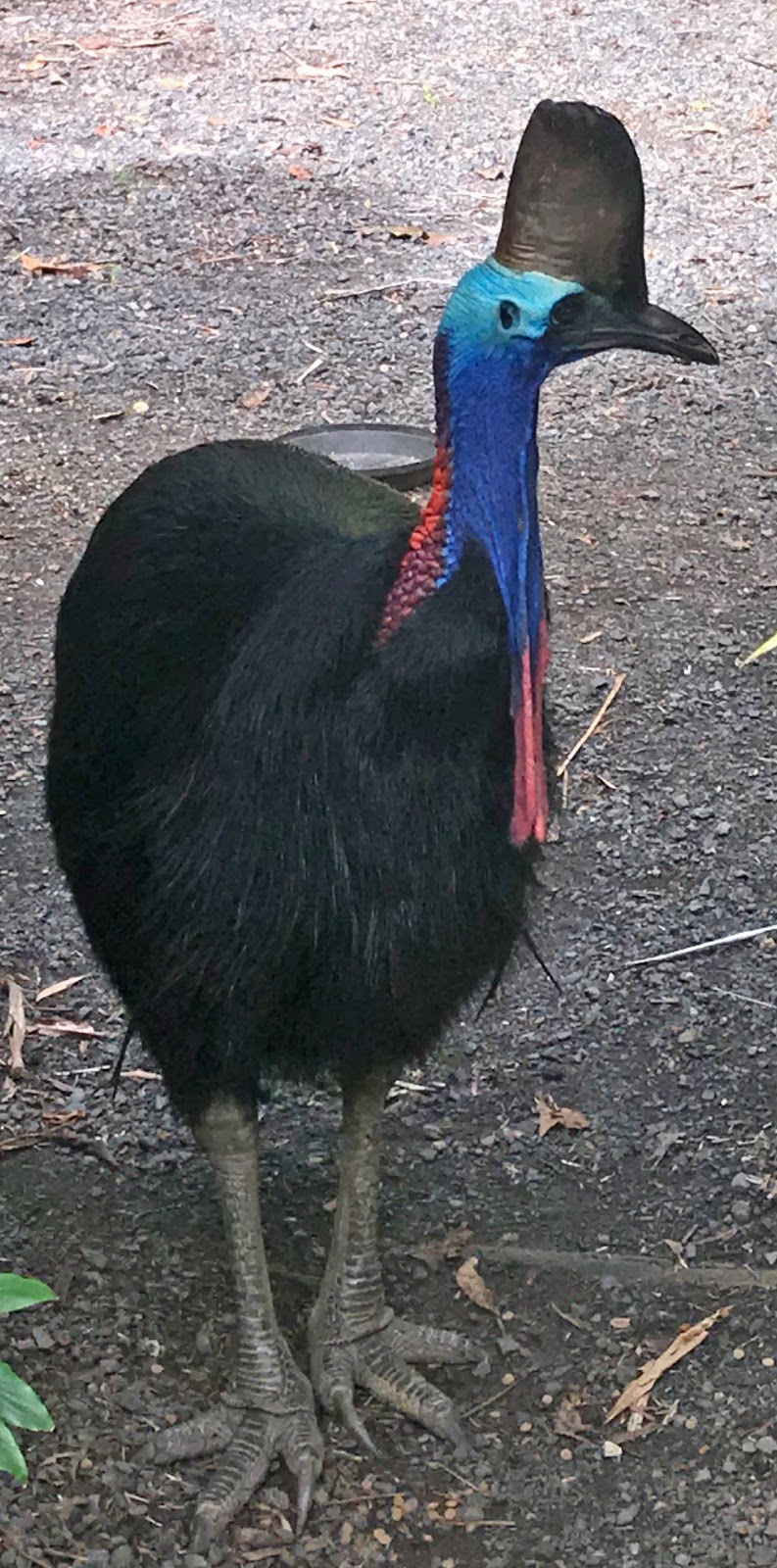
So what is happening? The male Cassowary is said to be 50-60 years old by people who have seen him all this time. His casque is chipped from ploughing through the understorey  but he does not seem to be worse for wear. His gait is normal and his hearing acute. One of his big toenails is almost gone but otherwise he appears normal.

Could it be that he has "decided" that four chicks was just to too many? Or has he some pereception that the food in the habitat is just not so plentiful this year and that he had to reduce his family so the three could survive? Who knows? Do birds get senile? 


Wednesday, 30 October 2024

2024 Baby Cassowaries---A Bonanza

 Mr Cassowary showed up for the first time this season with 4 chicks. They are largere than expected and are probably at least a month old.

They seem quite healthy and enthusiastic. They were even chasing the Brush Turkeys-a behaviour they learn from their father.

But what is their to be their fate? With habitat at a premium, will they be able to compete or will they be forced to the outer limits of the rainforest where suitable sustanance is at a premium? We may never know.


Saturday, 11 July 2020

Trick or Treat!

Most mornings a young cassowary comes to the front door. He a recent outcast from his father and is on his own. He/she seems to be doing ok as long as it avoids the sight of his father who will drive him from his territory.

Each year young cassowaries reach to proper stage in their development and they are driven away by their father. They hang around for a few weeks and then disappear never to be seen again. Where they go is a mystery. There is some effort to tag them and to try and determine just where they end up. Unfortunately, recently several have come to grief on the highway.

Friday, 10 April 2020

There's More!

Quite a surprise to meet Mr Cassowary and his 2 bubs for the year. He was a bit over anxious and I could not get any premium shots. The two chick look very healthy.


Cassowary Returns

After about 3 month's absence, we looked into our driveway and found Mrs Cassowary standing there. A welcome sight!


Oh, those big feet!

Wednesday, 5 December 2018

Cassowary Update

The three chicks are now two. We have no idea what happened to the third one but goannas, wild pigs and pythons are about.
After a feed, males decides to rest. One of the chicks is still active. Notice that the chick is a bit on the skinny side. This is probably a result of the drought conditions that have resulted in a rather sparse supply of food for foragers.
Both the adult male and his chicks often arrive wet. They probablybathe in the creek that is not far from our house.

Sunday, 10 September 2017

They're Back: Mr Cassowary and the Bubs for 2017


We've known about this years young cassowaries for about 6 weeks. They had been seen regularly at Cassowary House, not far from here. But this is the first visit  that we know of to this part of their range. We did not feel too bad about this because they have to cross busy Black Mountain Road to get to our place. It's rather extraordinary that the the male cassowary has done this for over 40 years and has not come to grief with a vehicle. Let's hope his luck holds out.


Tuesday, 3 May 2016

Meet the New Mrs--Cassowary, That Is

well here she is. She seems much larger than the other two female cassowaries we have had here. She has been named "Socks" because of her large, paired wattles. She seems to be a young bird. The feet are not scarred and the casque is smooth and even and without notches that accompany older birds from their trampling in the forest.

This poo sample consists mainly of palm fruits. She returns several times a day to feed as more fruits drop to the ground. Birds and mammals will feed on the exposed seeds and most will be carried off within a few days.

Saturday, 23 April 2016

He's Back-Mr Cassowary Returns

After a period of about 2 months, we had a visit from the local resident male cassowary. His chick had been run over by a vehicle on Black Mountain Road over the Easter Weekend.

There are so many trucks and other vehicles using Black Mountain Road, that we are always worried he will be hit when he crosses the road to get to Top of the Range.

Sunday, 20 December 2015

A Lovely Christmas Gift

 After a couple of months without any visits by a cassowary this fellow turned up.

 
 "It" is a juvenile, about 1/3 the size of an adult and lacking an adult casque. The colours and wattles are not yet fully developed. We won't know the sex for another several months.
 The bird is probably 2-3 years old

We hope it has a better fate than some of the others in the neighbourhood. Maurouding dogs and cars are their worst enemies.

Happy Holidays to All.

Thursday, 17 September 2015

R. I. P. Mrs Cassowary

Yesterday we had the sad news that Mrs Cassowary's body had been found on a property not far from our house. We had not seen her for about 3 weeks and have been wondering what has become of her. An autopsy may reveal the cause of her death.

This bird was unusually placid and often appeared with the male and with the chicks from time to time. This is the second adult female cassowary to die in this area in the past year. The other female was hit by a car on Black Mtn Road.

This leaves the male cassowary, and his sole chick, as the last adult in the area.

Cassowaries have been the subject of many entries on this blog. Simply search for "Cassowaries" and you can access all of them.

The autopsy reveals that the bird had a perforated bowel and died of blood poisoning. There was nothing in the gut to indicate what cause her malady.

At least she was not shot nor attacked by dogs.
DR

Sunday, 12 October 2014

He's Back!

We have been worried about Mr Cassowary. It has not been a good year for cassowaries around here. One of the new females was hit and killed by a car on Black Mountain Road a couple of months ago. We have seen the original Mrs Cassowary on a number of occasions. And we had heard that Mr Cassowary had two chicks this year some weeks ago. But we had not seen them. This did not worry us too much as logging and council trucks have been routinely using Black Mountain Road for over a year and it would be very dangerous for an adult cassowary to cross with one of more little chicks.

Well late on Sunday afternoon he appeared with one small chick. One is better than none!


there are lots of potential obstacles for this little fellow, especially this year. It is spring and hungry snakes and lizards are emerging from their winter slumber. It is exceptionally dry and food is scarce. With each footstep the cassowaries take, the leaves crackle and this could alert large predators like the 1m+ goannas that inhabit the forest. They could easily down a small cassowary but they would have to contend with its father and this would inhibit a goanna, especially if it had some experience along these lines. Pythons could also pose a problem at night but the chicks are usually tucked well under the father as they sleep. But a disturbance, like a troupe of marauding feral pigs, might cause him to bolt and abandon the chick.

Good luck to both. If the chick survives this season, it will be a very lucky bird. I will keep you posted.

Sunday, 27 May 2007

KOWAI SOO... POOR THING


A sad day. Baby Cassowary has been cast adrift by his father to face the world on his own. He has spent the day wandering around and calling with a high-pitched whistle that his father previously responded to. Now the rest of (his or her) life will be spent largely alone in the rainforest looking for fruits and small organisms for food. If it's lucky and avoids being attacked by dogs or pigs and does not venture on to the highway, the Cassowary can expect to live a relatively long life. Females have been known to take as many as three mates in succession, and produce more than one clutch of eggs per year of which 2-3 will hatch. After egglaying is complete, she leaves him to incubate and rear the chicks. He is in full charge for many months. Once he runs off the young Cassowaries, in the manner of domestic chickens, it takes about 2-3 years for the chick to mature. During this time, the young Cassowary may venture in other Cassowary's territories and be run off. Eventually it will establish its own territory and establish routes where preferred trees are fruiting or there are other reliable food sources.