Translate

Showing posts sorted by date for query Boyd's. Sort by relevance Show all posts

Friday, 18 October 2024

Spring is Springing

 Remember to click on the photo to enlarge

With the warm weather approaching, some interesting things are to be seen in the rainforest after dark.

All of a sudden this fellow, a Boyd's Forest Dragon, has been appearing at the light sheet every so often, cleaning up the larger moths. Could this be the same dragon that used to sleep in the tree next to the light sheet all those years ago? See https://bunyipco.blogspot.com/search?q=forest+dragon
Male Hercules Moth, Coscinocera hercules, a common visitor to the light sheet in late spring. The moths come in the wee hours of the morning, not usually shortly after dark.

This katydid, Austrosalomona destructor, is spending the day on a ginger leaf. It is a nocturnal katydid that is an opportunist. It will feed on floral parts and any insects that is can subdue.
This moth is a member of the family Thyrididae, Oxycophina theorina, and has a distinctive stance.

A member of the family Uraniidae, this moth, Phazaca sp, appears to have torn wings. But they are just folded underneath. It is in perfect condition.
Doddiana callizona is name in honour of Dodds, the Butterfly man of Kuranda.

A member of the family Lymantriidae, Euproctis fimbriata
Geslasma orthodesma, one of the many greenish Geometridae.
Most Geometridae are rather drab, relying on their colour pattern to conceal them from predators as they rest during daytime. This one is Noreia vinocea.

Then there is Hypsidia erythropsalis, a member of the family Drepanidae-anything but dull.
Some moths do not look like moths. This is an Arctiidae, Manulea sp.
Pygospila tyres, family Crambidae, is a wonderful example of the family.
An unknown Geometridae.
The Two-spotted Silent Cricket, Unka boreena, like the bane suggests, is silent and produces no calling song. It wanders about on leaf surfaces after dark feeding on the particulate matter that falls out of the canopy.
A member of the family Pyralidae, this moth, Vitessa zemire, is quite spectacular. Note the white annulations on the antennaThis gives the impression that antennae are shorter than they really are. This provides the moth with an "early warning device" to compete with predators.
One of the many fulgoroid treehoppers that can often be found on the lightsheet.

There are probably more than 20 species of the beetle family Scarabaeidae that come to the light sheet.
Batocera longicornes are always a spectacular site when they are found in the rainforest.


A wonderful longicorne, Tricheops ephippiger.
A Flat Bark Beetle, family Cucujidae, Platiscus integricollis, lives under bark but emerges after dark to seek new habitats and mates.
The katydid, Caedicia kuranda, is present almost the year round in the Kuranda rainforests.


Lastly a small cockroach, Celatoblatta sp., with a gooey substance on its posterior segments. Originally thought to be a sexual attractant, it turns out that is acts as a deterrent to would-be predators like spiders and lizards. They get "all caught up" in the sticky goo and quickly earn to avoid these insects.


Sunday, 17 March 2019

recent visitors

Click on the images to enlarge
Must be the season for visitors
This peahen has been around the garden for the past week. It comes right up to the door and would come into the house if it got the opportunity. Imagine the kerfuffle with a bird this size flying around the house. It has happened with Brush Turkeys and an open door!

I saw something scamper across the turkey's mound and went over to investigate and this fellow hopped onto an adjacent tree. It's a Boyd's Forest Dragon, Hypsilurus boydii. It's been a long time since I have seen one of these on the property, see http://bunyipco.blogspot.com/search?q=Boyd%27s

But look carefully.
There were actually two! How lucky. But I haven't seen them since!

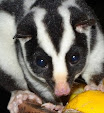
What's this high in the Jakfruit tree?
It's a striped possum in its glory--inside a rotting jakfruit. See: http://bunyipco.blogspot.com/search?q=Striped. These animals feed on a variety of foods and can be heard in the trees when they find something of interest. They are usually very wary.

Saturday, 30 June 2012

OOPS!

An Unexpected Visitor
The other day an unexpected visitor appeared on the ground in mid afternoon. It is Morelia spilota, one of the six subspecies or races of the Carpet Python. Now which one is the one in the garden. Well is could be the Jungle Carpet Python, M. s. cheynei or the Coastal Carpet Python, M. s. mcdowelli.


This one seems to have characters of both subspecies or races. This is probably because this individual is hybrid between the two. But since they are the same species, they share the same genetics. If the two races overlap, then a blending of characteristics should result in the offspring. In any case, this fellow appeared in the daylight and was very unexpected. I  almost stepped right on the poor thing.


 The snake was not disturbed by my presence. But it was on the hunt, searching on the ground and in shrubbery.
It checked out this small tree and eventually came to ground and disappeared into the bush. This python is fond of taking up residence in attics and rooftops. It feeds on mice, various mammals and birds. Sometimes pets are taken and if the pet was wearing a flea collar, the snake could be in trouble and die from the expericens
 And that's the end of the tail (tale) of the Python. Moral: Always watch where you step in the rainforest.
One of the locals who watched the entire proceedings But he had no worries. The python would not be interested in this Boyd's Forest Dragon.


Thanks to both Michael Cermak and Alan Henderson for comments and icentifications.

Wednesday, 25 January 2012

Just Guarding

 Our resident Amethystine Python spent some hours watching and waiting for something to show up along a drain during a recent storm. I was hoping he did not detect the Boyd's Forest Dragon sleeping on a branch not far from where he was.
The head shows an interesting pattern of scales.

Wednesday, 18 January 2012

A Bit Of A Mystery

For the past few years I have  been observing the strange antics of some peculiar "tube critters". These creatures, which appear to be caterpillars, start out by anchoring themselves to a particular spot on the bark of certain select trees. In this case, the Kuranda Quandong, Elaeocarpus bancroftii. As they develop, the case lengths to an ultimate length of about 80 mm. They operate in the radius dictated by their anchor and seem to be feeding on bark. After several months in the same spot, the surface of the tree does not seem to have changed in appearance at all. Selected trees bare 20 of these creatures within a couple of metres of the ground.

The case consists of phrass-bits and pieces of the bark and faecal matter. When Murray Upton visited last year we observed these creatures feeding an moving about on their tethers. At Thanksgiving we captured a few and kept them in humid containers but no adults eventuated. Now the tubes are disappearing, probably being broken up by the weather and ants which were seen around them months ago but that cause no harm. So we must wait till next year to attempt to see what these insects are. We think they are case moths, family Psychidae, but can't be certain until we see an adult.

The other mystery involves white creatures on this patch of lichen. Look carefully and you can see several elongate lumps!
 Each one has an amorphous shape. As a group, they "twitched" from time to time and they moved from place to place but for weeks stayed on the single patch of lichen. Other trees and patches were searched but no other sightings were recorded.
Then recently the group disappeared. I though the resident Boyd's Forest Dragon may have either eaten them or disturbed the group when he scuttled up the tree. Then one appeared on the light sheet in an apparent attempt to pupate. It is now in a container and we await the emergence of this odd insect.

They may be geometrid loopers that cover themselves with lichen. They inch along in the pattern of geometrid caterpillars but I've never heard of a geometrid that covers itself with its host plant.

Friday, 11 November 2011

Return of an Old Friend

Boyd's Forest Dragon munching on a Cane Beetle at night in front of the light sheet.


I was startled the other night when I was in front of the light sheet looking up and something ran across my feet. It turned out to be the Boyd's Forest Dragon, Hypsilurus boydii. I'm sure it was the same individual written about previously in these blogs because he (or she) sleeps on the same branch as it did in 2007 when it was noted here for the first time. It has been 11 months since I have seen this lizard. I thought maybe it had gone to its eternal reward!


A typical pose for Boyd's Forest Dragon--on a tree trunk attempting to be unnoticed.

Sunday, 12 September 2010

Miscellaneous Miscellany

Garden Miscellany

A number of “creatures of interest" have appeared in the past few days and here they are!

The flowering of one of our Amorphophallus plants (see Aroids) has attracted some interested observers. This Rove beetle, is active by day and its slow swooping flights can be frequently seen, especially if a Cane Toad, for example, has been killed in the driveway or run over by the mower. It is more colourful than most Rove beetles. It is said to be a predator and so would be looking for prey at a source that would attract them, like a stinky Amorphophallus flower.

The Rove Beetle, Actinus macleayi, family Staphylinidae.


St Andrew’s Cross Spider, Argiope keyserlingi is a widespread spider and everyone who is observant in the garden has seen it. The X is called a “stabilimentum” and apparently has a number of functions. It is thought to attract insects. It’s silk is different from the rest of the web and reflects UV light that may attract pollinating insects using UV to find flowers. It is also hypothesized that it helps the spider to camouflage itself and additionally warns birds that there is a web there. When annoyed, the spider shakes the web vigorously and the startle effect of the “X” may help in convince the attacker that it should move on.


St Andrew's Cross Spider, Argiope keyserlingi in its web.


A case of mistaken identity

I was surprised when this creature appeared at the light. At first I thought it was an odd Milionia queenslandica Jordan and Rothchild. A closer look revealed it was a butterfly. The Purple Dusk-flat, Chaetocneme porphyropsis (Meyrick & Lower) is a skipper butterfly with a very restricted geographic distribution. It is known from from Cape Tribulation to the Paluma Range near Townsville. The caterpillars feed on several rainforest trees and at least one introduce tree, Cinnamomum camphora. See Braby (2000: 68).

The Purple Dusk-flat, Chaetocneme porphyropis, family Hesperiidae; Pyrginae

Milionia queenslandica Jordan and Rothchild, family Geometridae, Ennominae.

Similarities don’t end there.

This little moth, Synechodes coniophora, is active during the day flying like the wind and alights only for a fraction of a second. It also flies at night since the moth is found occasionally at the lights. The caterpillars bore into the stems of palm flowers and fruits, especially Lawyer palms, Calamus spp. I find them buzzing around the giant Oil Palm we have in our driveway.

Synechodes coniophora Turner; family Brachodidae.

Love Bugs, flies of the family Bibionidae, Plecia ornaticornis ( see Love Bugs)are commonly seen on flowers during the day and around lights at night. They seem to be shunned by vertebrate and invertebrate predators alike. Ants avoid them. Birds leave them on the light sheet and my friend the Boyd’s Forest Dragon doesn’t touch them. Their similarity to the Synechodes moth is striking but the resemblances don’t end there. The cantharid beetle fits these criteria too. They are probably part of a Mullerian Mimicry Complex. See Mullerian Mimicry).

Plecia ornaticornis; family Bibionidae


Elegance in moths!

Barnatola panarista (Turner) has been seen on this site before but it is a beaut little moth. Nothing is known of its biology.

Barantola panarista (Turner); family Depressariidae.


Luxuriating Turkeys

These turkeys are taking advantage of the warm spring weather to do a bit of “anting”. They lay down in the sun and expose their feathers and look very silly. The warmth of the sun kills lice (Mallophaga) that live on the feather shafts. These parasitic insects are very sensitive to temperature. They die if it varies only a degree or two. That’s why bird lice don’t survive for long on humans. We are just too cold for them.

The wonders of spring!

All but unconscious in the sun!

References

Braby, M. 2000. Butterflies of Australia: Their Identification, Biology and Distribution. Volume one. CSIRO Publications, Collingwood, Vic. 457 pp.