Growing up in northern California and collecting beetles as a boy I always took the challenge to chase the fast-moving and visually acute Tiger Beetles (family Carabidae, subfamily Cicindelinae). But it always seemed that the species was the same, Cicindela oregonensis, whether we were collecting along the coast or along mountain streams in the Sierra. Rarely, one could find a real treasure, the large black Tiger Beetle, Omus. These beetles live in a different habitat--under bark, and prophetically, under the bark of downed eucalyptus trees where you usually encountered very little-- Sow Bugs (crustaceans) or certain tenebrionids. But I digress.
In Australia we see Tiger Beetles at the light sheet every night during the summer season and they can be spotted during the day where they actively pursue small insect prey. I have noted this before in this blog. I often see these beetles on tree trunks in the rainforest facing head downwards awaiting unsuspecting insect meals during the day. Recently at a site in a mixed eucalypt-acacia forest along the Clohesy River we found two species of the genus Dystipsidera. When spotted during the day on tree trunks, these beetles are alert and very difficult to approach. With their propensity to be attracted to lights, I had thought that they might be nocturnal. They are known for their extraordinary eyesight and could potentially see on bright, moonlit nights.
Two species were spotted sitting on leaves or grasses and they seemed to be active. But they were within 15m of the light sheet and that could have prompted their movements.
Dystipsidera flavipes is the larger of the two species and lacks the brown markings of its relative.
Dystipsidera sericea is the smaller of the two and seems to be less common.
Cicindela sp probably semicincta, is a widespread, Cosmopolitan genus of Tiger Beetle. Here is devours an ant that has come to light. The larva of these beetles construct vertical subterranean burrows and protrude their heads with the massive jaws that seize any unsuspecting passing insect. As note, members of this genus seem to be found not far from waterways.
Always something of interest in this great country.
Showing posts sorted by relevance for query tiger beetles. Sort by date Show all posts
Wednesday, 6 February 2013
Saturday, 6 December 2008
A Few Interesting Beetles

A Few Interesting Beetles
Each morning there is an array of beetles of many species at the light sheet. The species component varies with the season and flowering and fruiting of the vegetation. As with all insects, each has a particular biological story. Many we are yet to unravel. Here are a few highlights.
Many scarabs come to the lights, some apparently from great distances. Here we have the Grey-backed Cane Beetle. This large scarab is a pest of sugar cane and is responsible for the intrduction of Australia's greatest pest since the introduction of the "white"man', the Cane Toad, Bufo marinus. This beetle attacks sugar cane from beneath. The grubs feed on the roots causing considerable damage to the crops. Cane toads would never encounter the grubs since they only burrow in the colder months to sleep. They would only encounter the adults on a chance basis since the adults are airborne most of the time and seldom come to ground. In general, one of the least likely places you would encounter a Cane Toad would be in a cane field. They avoid dense plantings. This is true to some extent o the rainforests. They only occur there when times are tough and food is scarce. Normally you would not encounter Cane Toads in rainforests.


The Grey-backed Cane Beetle Dermolepida albohirtum (Waterhouse)
Green scarabs, like this one, Anoplognathus punctulatus, are frequently found on the light sheet. Interestingly, they are not picked off by the several species of birds that arrive every morning at day break for their breakfast. Are they distasteful? Or is the search image on the sheet one that the birds just don't recognize?

One of a number of green scarabs found at lights in the wet season.

Anoplognathus aureus is one of a number of species called Christmas Beetles. This little jewel apparently deceives predators by appearing to be a spot of reflected sunlight on a leaf.

I took this photo of a scarab similar to A. aureus in Costa Rica. It is unrelated and is a great example of convergence.

The Rhinoceros Beetle Xylotrupes ulysses australicus (Thomson) is common along the coast from Sydney to southeast Asia. They always attract attention when they are found at lights. Males have an elongated horn that is used in jousting with other males. These beetles are often kept as pets in Asian countries. They are easy to keep. Adults feed on a variety of fruits and the large grubs can be raised on leaf litter with a generous supply of dry dog biscuits.

Tiger Beetles (Carabidae; Cicindelinae) are usually encountered along ocean shores or along streams. There are a few, like Distipsidera undulata, that occur on tree trunks where they hawk passing insects. This one is an infrequent visitor at the light.

Rhipiphorid beetles are special--but they don't look very special. Females are usually wingless and lack mouthparts. This suggests something special. They are parasites of other insects. This one is probably Rhipidioides and is probably a parasite of cockroaches, and probably those in the family Blaberidae. [If you're into cockroaches, this is the place. I've found about 70 species here, mostly in the Blattellidae]. The first instar is a triungulin larva that travels around at a fast rate looking for the appropriate host. Hosts of other genera include wasps, bees, flies and some other beetles.

Melitomma sp. is a member of the Lymexelidae, another beetle family with somewhat peculiar habits. The larvae are wood-boring but feed not on the wood but on the ambrosia fungi that grow on the walls of their burrows. Females have pouches near the end of the abdomen where they store the fungi that are later deposited with the eggs. When the eggs hatch, the young larvae "infect" the walls of their new burrows with the fungi that grow and nourish them.

Longicorne Beetles (Cerambycidae) range in size from beetles a few millimetres long to some giants over 70 mm. The larvae bore in wood, roots and other plant material. It is a large family and being in a rainforest you would expect an impressive array of species. And such is the case.

Coptocercus biguttatus is one of many in the genus. They are distinctively marked and come to lights or can be found on flowers during the daytime.

Many longicornes assume unusual patterns at rest. This is to deceive potential predators. Being wood borers, most species possess formidable mouthparts. It is always intriguing to watch the assortment of Black Butcherbirds, fantails, robins and the inimitable Brush Turkey, attack beetles in the morning. One bite from the beetle could snap off a toe or remove the tongue of the bird, but I have never seen a mishap. The birds know how to approach the resting beetles and they take precautions.
More on beetles later.
Sunday, 24 February 2019
Heads Up
Remember to click on the photo to enlarge
A close-up look at the heads of many insects suggest their function---sometimes, but not always.
Tiger Beetles, Carabidae, Cicindelinae, are not named for tiger-like stripes but for their predaceous habits. Most are diurnal and patrol stream and lake shores where they hawk smaller insects. Not all have such habits, see. In north Queensland several species perch on leaves and tree trunks and lie in wait for unsuspecting prey.
Other beetles like the long-horn Rosenbergia megalocephala, possess powerful mandibles that can deliver a painful bite, but that is not their primary function. These beetles are wood borers and require strong mandibles to tear into rotting wood to lay their eggs.
Rosenbergia megalocephala is a fairly common visitor to the lights in the rainforests of Kuranda.
A close-up look at the heads of many insects suggest their function---sometimes, but not always.
Tiger Beetles, Carabidae, Cicindelinae, are not named for tiger-like stripes but for their predaceous habits. Most are diurnal and patrol stream and lake shores where they hawk smaller insects. Not all have such habits, see. In north Queensland several species perch on leaves and tree trunks and lie in wait for unsuspecting prey.
Other beetles like the long-horn Rosenbergia megalocephala, possess powerful mandibles that can deliver a painful bite, but that is not their primary function. These beetles are wood borers and require strong mandibles to tear into rotting wood to lay their eggs.
Rosenbergia megalocephala is a fairly common visitor to the lights in the rainforests of Kuranda.
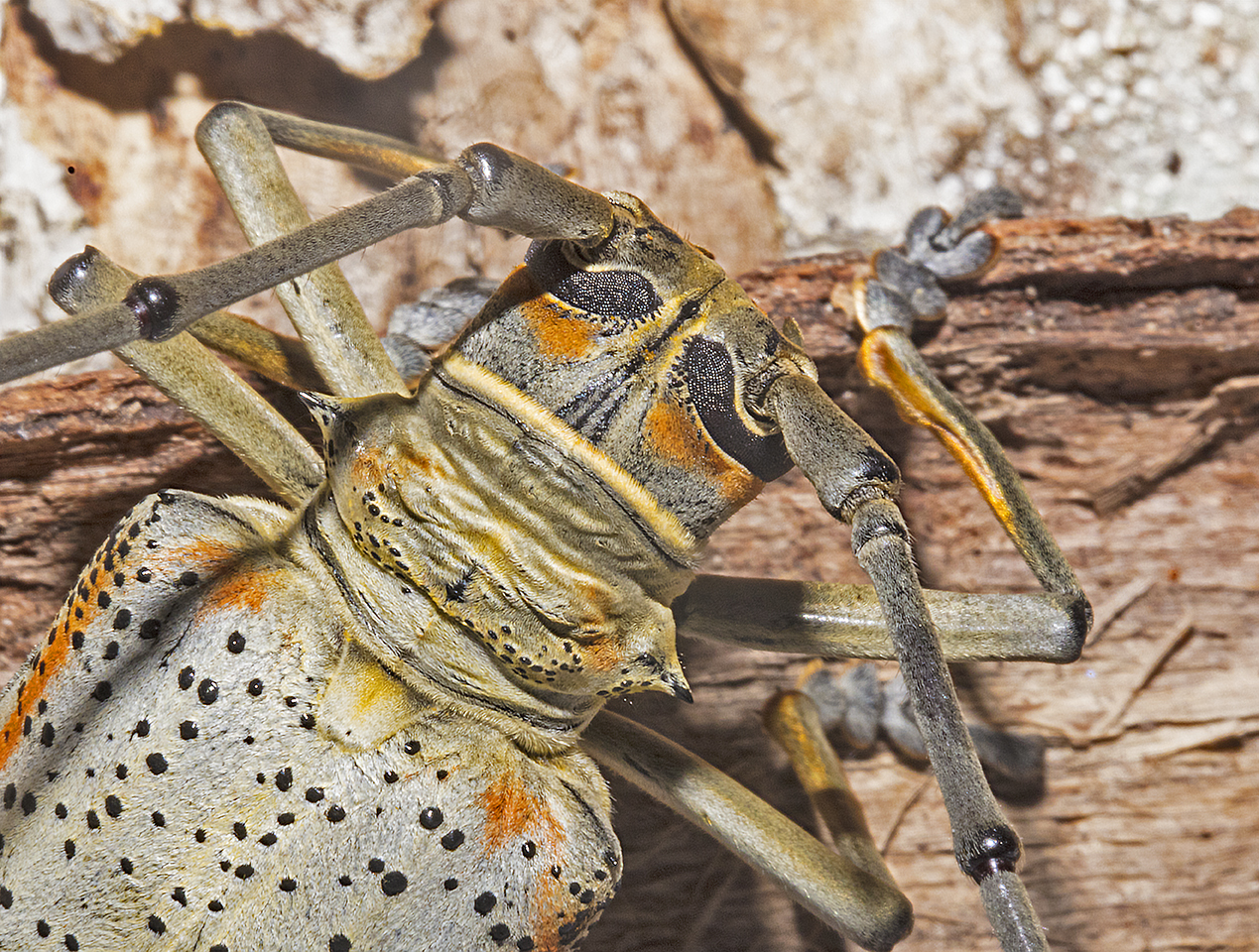
It is a stunning large beetle and a favourite amongst beetle collectors.
The mandibles are massive and flattened for scooping and tearing. Massive muscles provide these beetles with effective defence as most beetle collectors can confirm.
The giant longhorn, Xixuthrus microcerus, is amongst the largest of long-horns in the far north of Australia. It is fairly common and capable of a very effective bite. The elytra are very flexible and if the collector (or other predator) is unwary, the beetle can easily rotate its body and deliver a stunning bite.
Lymexylid beetles often come to the light sheet at night. They can be found during the day in leaf litter or, more rarely, at flowers. This one is in the genus Melittomma. Larvae of some species tunnel in decaying wood and feed on associated fungi. The stains that result cause the timber to be worth less to the industry and the beetles are consideered pests.
The mouthparts are very small and somewhat retracted into the head.
Lymexylid mouthparts are small compared to many other beetles.
Stag beetles (Lucanidae) are so-called because of their large mandibles. In males the mandibles are not used for wood-boring but in jousting with rivals for females.
Ryssonotus nebulosus males are impressive. The internal surface of each mandible is lined with brown hairs. This beetle has been found to breed in introduced willows as well as several native Australian trees.
The most iconic of Queensland beetles is Phalacrognathus muelleri. The length and development of mandibles varies in males. The individuals with the largest mandibles are said to be "preferred" by females.
Labels:
heads,
long-horns,
mandibles,
melandryids,
stag beetles,
tiger beetle
Wednesday, 15 February 2017
A Few nice Beetles From Kuranda
A selection of beetles from around the garden.
Click on the image to enlarge.
Anoplognathus aeneus, a Christmas beetle that's a bit late!
A brentid weevil probably brentid Miolispa australiana .
Chrysomelidae, a Leaf Beetle, Promechus australica
Promechus australica, larva. The beetles and their larvae have just about defoliated a small Celery Top tree, Polyscias elegans.
A Tiger Beetle, Dystipsidera flavipes. Did a blog on the tiger beetles in 2012.
Ectocemus decemmaculatus, a lovely brentid weevil
Leptopius quadriens, a common weevil about the place.
Lymexylidae Melittomma sp. Sometimes very common at the lights.
Tenebrionidae, Cyphaleus ducalis A very large tenebrionid that apparently flies.
A Trogidae. These beetles feed on decaying animals matter.
Orthorhinus cylindrirostris, one of the more photogenic weevils.
Saturday, 4 February 2012
A Tiger Of A Beetle
I have reported on Tiger Beetles before on this blog. One sunny morning, I found this typically bark-running species sitting on a leaf in the sun. That presented an unusual photo opportunity.
Tree-running Tiger beetle Dystipsidera flavipes Macleay, family Carabidae; Cicindelinae
The mandibles are for capturing and holding small prey.
There are at least two species in this genus in Australia. D. flavipes normally perches head downwards on rainforest trees where it captures unsuspecting passing insects. These beetles are frequently attracted to lights suggesting they may be at least partially nocturnal.
Tree-running Tiger beetle Dystipsidera flavipes Macleay, family Carabidae; Cicindelinae
The mandibles are for capturing and holding small prey.
There are at least two species in this genus in Australia. D. flavipes normally perches head downwards on rainforest trees where it captures unsuspecting passing insects. These beetles are frequently attracted to lights suggesting they may be at least partially nocturnal.
Friday, 15 March 2013
Night Wanderings
It has been an unusually dry wet season in the far north of Queensland. To the south it is a different story with record rains and floods in south Queensland and northern New South Wales. The February rainfall averages from 100-600 mm in Kuranda. This year we received 114 mm.
The insects have been patch at best but here are a few examples from recent forays into the local bush.
The Tinaroo Road near Mareeba offers a number of different habitats ranging from wet eucalypt-acacia woodland to rather dry, sparsely vegetated mixed woodland. Along the creeks, there is gallery forest and natural grassland---where it has not been devastated by grazing and burning.
Antlions are frequent visitors to the lights, especially in mixed woodlands.
This caterpillar was found on the tip of a Causarina needle
This Brown Tree Snake, Boiga irregularis, stopped by. It positioned itself on a shrub near the light-sheet and remained there for about 10 minutes after sizing up the situation and deciding there was not much use in hanging around. It is a rear-fanged colubrid snake that feeds on birds, lizards, bats and small mammals. A large example is 2 m but most snakes are much smaller than that.
The Brown Tree Snake is often called the Night Tiger because of its striped pattern. It is responsible for devastating the bird population of Guam due to its inadvertent introduction there.
The Snake Mantid, Kongobatha diademata Hebard, waiting to ambush passing prey.
Cedarinia costata Sjøstedt, female.
Caledia captiva (Walker): Acrididae; Acridinae; Acridini is a grassland species commonly found along forest margins or at the edges of walking tracks. The white band near the tip of the hind femur is distinctive of this grasshopper. It is distributed along the east coast of Australia and into the tropics and in the coastal areas of the Top End, that is northern Northern Territory and northern Western Australia. It's genetics have been studied in the past by Dr Dave Shaw and his colleagues at the Australian National University.
Grass-straddler, Rhachidorus longipennis Rentz: Tettigoniidae; Tettigoniinae; Nedubini uses its long legs to position and steady itself in tall grasses where it feeds on pollen and seeds at night. The tarsi of the hind legs are elongated to help it grasp the stems. This genus, and several others in Australia, is distantly related to those in both southern Africa and the Pacific northwest of North America.
Caedicia sp.: Tettigoniidae; Phaneropterinae probably pictipes Stål abroad after dark.
Caedicia sp.: Tettigoniidae; Phaneropterinae probably pictipes Stål, a last instar nymph with banded hind tibiae.
Male Johnrehnia sp.: Ectobiidae; Blattellinae feeding on eucalypt trunk. Females of this species are black. This was one of three Johnrehnia species found a this site. Nothing is known of their activities. Some species of the genus are commonly found in leaf litter but the activity patterns, ecological requirements and and feeding habits of most blattellines are largely unstudied in Australia.
The insects have been patch at best but here are a few examples from recent forays into the local bush.
The Tinaroo Road near Mareeba offers a number of different habitats ranging from wet eucalypt-acacia woodland to rather dry, sparsely vegetated mixed woodland. Along the creeks, there is gallery forest and natural grassland---where it has not been devastated by grazing and burning.
Antlions are frequent visitors to the lights, especially in mixed woodlands.
This caterpillar was found on the tip of a Causarina needle
This Brown Tree Snake, Boiga irregularis, stopped by. It positioned itself on a shrub near the light-sheet and remained there for about 10 minutes after sizing up the situation and deciding there was not much use in hanging around. It is a rear-fanged colubrid snake that feeds on birds, lizards, bats and small mammals. A large example is 2 m but most snakes are much smaller than that.
The Brown Tree Snake is often called the Night Tiger because of its striped pattern. It is responsible for devastating the bird population of Guam due to its inadvertent introduction there.
The Snake Mantid, Kongobatha diademata Hebard, waiting to ambush passing prey.
A March Fly. This year they are actually active in March. Females bite ferociously but males like this one lack the mouthparts to provide a blood meal. They feed on nectar and often come to lights suggesting they are nocturnal. Females bite during the day and almost never are seen around lights. Males have large eyes that meet on the top of the head. We have dealt wit this aspect of their life history before.
A pair of mating long-horned beetles. This species seems to be associated with grasses.
Late afternoon is a good time to photograph diurnal grasshoppers as the ambient temperature winds down and they decrease their activity. This a male of what appears to be Cedarinia costata Sjøstedt. The dorsal stripe is generally atypical of this species.Cedarinia costata Sjøstedt, female.
Caledia captiva (Walker): Acrididae; Acridinae; Acridini is a grassland species commonly found along forest margins or at the edges of walking tracks. The white band near the tip of the hind femur is distinctive of this grasshopper. It is distributed along the east coast of Australia and into the tropics and in the coastal areas of the Top End, that is northern Northern Territory and northern Western Australia. It's genetics have been studied in the past by Dr Dave Shaw and his colleagues at the Australian National University.
The Black-faced Theomolpus, Theomolpus pulcher (Sjøstedt); Acrididae; Catantopinae; Macrotonina is aptly named. It has a rather limited distribution in the tropics south of the Daintree Region. There is one other species in the genus known from Cooktown.
Adult male Black-faced Theomolpus, Theomolpus pulcher (Sjøstedt); Acrididae; Catantopinae; Macrotonina.
A matchstick grasshopper, Morabidae; Morabinae (formerly family Eumastacidae) at night on Casuarina needle. These grasshoppers appear to be nocturnal.Grass-straddler, Rhachidorus longipennis Rentz: Tettigoniidae; Tettigoniinae; Nedubini uses its long legs to position and steady itself in tall grasses where it feeds on pollen and seeds at night. The tarsi of the hind legs are elongated to help it grasp the stems. This genus, and several others in Australia, is distantly related to those in both southern Africa and the Pacific northwest of North America.
Caedicia sp.: Tettigoniidae; Phaneropterinae probably pictipes Stål abroad after dark.
Caedicia sp.: Tettigoniidae; Phaneropterinae probably pictipes Stål, a last instar nymph with banded hind tibiae.
Male Johnrehnia sp.: Ectobiidae; Blattellinae feeding on eucalypt trunk. Females of this species are black. This was one of three Johnrehnia species found a this site. Nothing is known of their activities. Some species of the genus are commonly found in leaf litter but the activity patterns, ecological requirements and and feeding habits of most blattellines are largely unstudied in Australia.
Subscribe to:
Posts (Atom)