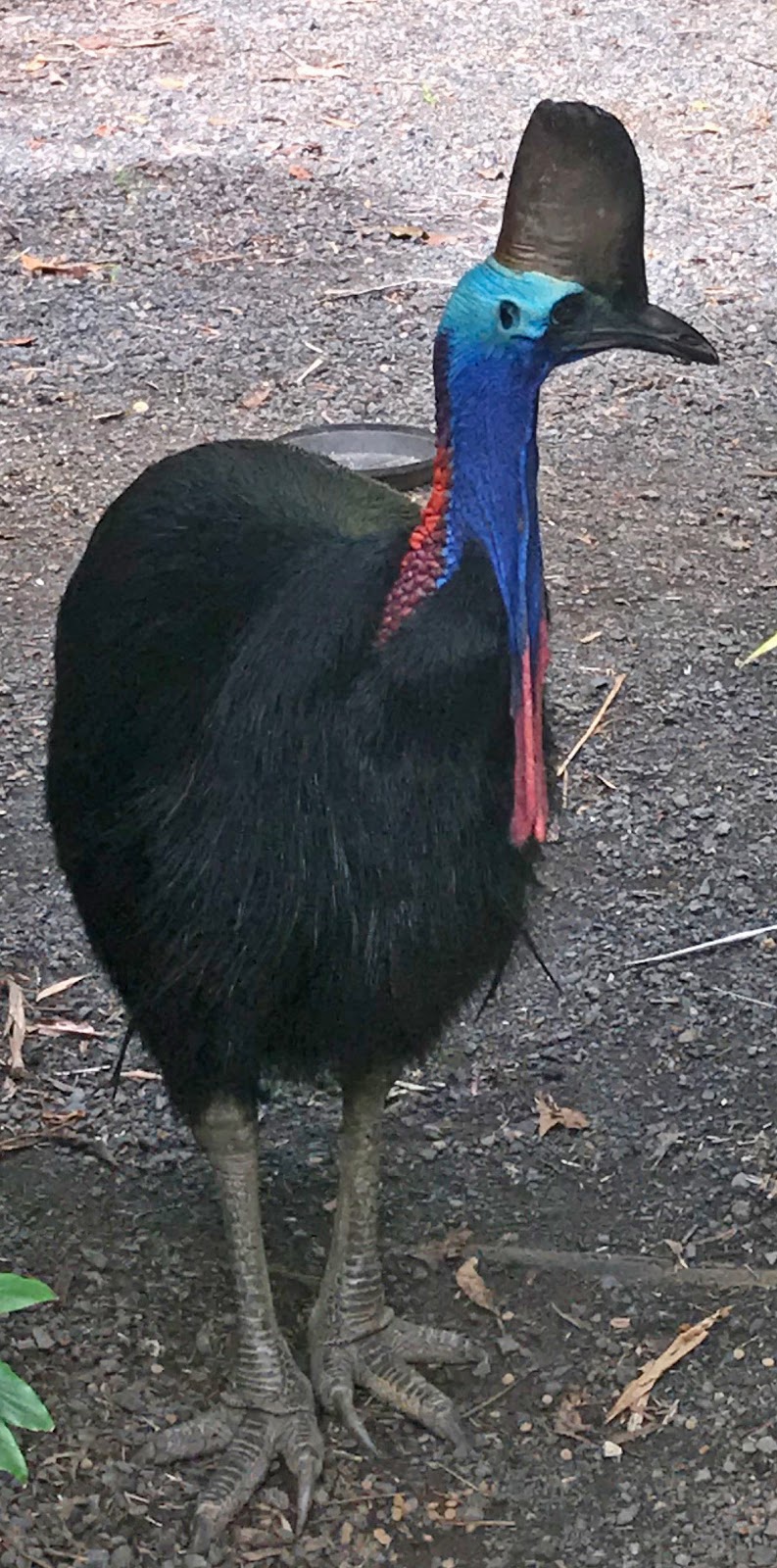
Most mornings a young cassowary comes to the front door. He a recent outcast from his father and is on his own. He/she seems to be doing ok as long as it avoids the sight of his father who will drive him from his territory.
Each year young cassowaries reach to proper stage in their development and they are driven away by their father. They hang around for a few weeks and then disappear never to be seen again. Where they go is a mystery. There is some effort to tag them and to try and determine just where they end up. Unfortunately, recently several have come to grief on the highway.
Saturday, 11 July 2020
Sunday, 5 July 2020
The Giant White-tailed Rat
The Giant White-tailed Rat (Uromys caudimaculatus) is just that. A large specimen may weigh 1 kg! These rats are common in rainforests where they have an omnivorous habit feeding on seeds, fruits and small animals. They cause considerable grief to their human neighbours when they chew on plastic and electrical components of automobiles and electric cables in ceilings. Anyone living in the tropics can relate stories to the depredations caused by these creatures.
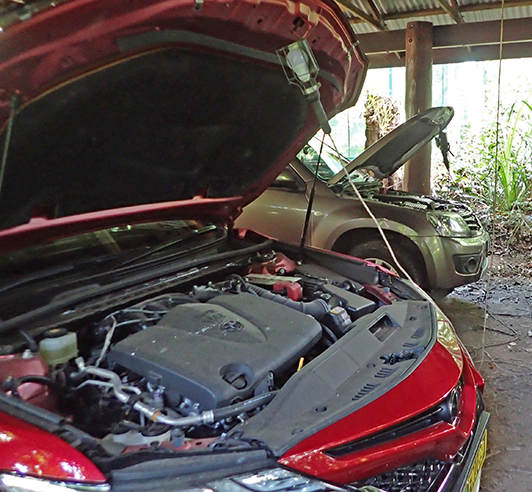
Residents have discovered a way to cope with White-tailed Rat damage to vehicles is to open the bonnet at night and place a low wattage light over the engine. A bit costly to the electricity bill but nothing when compared to the damage a chewing rant can do after dark.
The power in the jaws and the efficiency of the teeth of the rats is seen on the ground where seeds so tough that it would take a mallet to smash them bear the characteristic chew holes of the rat.
Some people trap and kill the rats but they are a native to the area and belong here, we don't. And it is against the law. So we trap the rats and move them many kilometres distant to areas where they can cause no harm--we think.
Giant White-tailed Rats are formidable. When confronted they emit frightening vocalisations and bear their teeth. Care must be taken when dealing with these creatures. Have a listen to the vocalisations of the caged rat bclicking on the link below!
https://soundcloud.com/dave-charles-16/giant-white-tailed-rat-uromys-caudimaculatus
Residents have discovered a way to cope with White-tailed Rat damage to vehicles is to open the bonnet at night and place a low wattage light over the engine. A bit costly to the electricity bill but nothing when compared to the damage a chewing rant can do after dark.
The power in the jaws and the efficiency of the teeth of the rats is seen on the ground where seeds so tough that it would take a mallet to smash them bear the characteristic chew holes of the rat.
Some people trap and kill the rats but they are a native to the area and belong here, we don't. And it is against the law. So we trap the rats and move them many kilometres distant to areas where they can cause no harm--we think.
Giant White-tailed Rats are formidable. When confronted they emit frightening vocalisations and bear their teeth. Care must be taken when dealing with these creatures. Have a listen to the vocalisations of the caged rat bclicking on the link below!
https://soundcloud.com/dave-charles-16/giant-white-tailed-rat-uromys-caudimaculatus
Thursday, 16 April 2020
A Gecko Bites the Dust
It must be an evolutionary embarrassment for a vertebrate to meet its fate at the hands (or fangs) of an invertebrate. It happens often. Giant centipedes capture nesting birds and roosting bats; large spiders capture birds, lizards and even small snakes.
We have been watching a large Golden Orb-weaver (Nephila pilipes) just outside our bedroom window and discover this morning that it had somehow captured a fairly large gecko overnight. It is probably an Asian House Gecko as they are fairly common both inside and outside the house. But they don't venture far from human habitation.
The photos are not the best because of the precarious position of the spider, my age, and my wife! But look closely and you will see a male spider on the abdomen of the female as she tends to her prey.
We have been watching a large Golden Orb-weaver (Nephila pilipes) just outside our bedroom window and discover this morning that it had somehow captured a fairly large gecko overnight. It is probably an Asian House Gecko as they are fairly common both inside and outside the house. But they don't venture far from human habitation.
The photos are not the best because of the precarious position of the spider, my age, and my wife! But look closely and you will see a male spider on the abdomen of the female as she tends to her prey.
Note two males.
The small spider is the male of the species--just waiting for his opportunity to mate
Look closely and you will see the head and eye of the prey.
Friday, 10 April 2020
A not-so-welcome resident
A mall Red-bellied Blacksnake has apparently taken up residence around the place. He probably is attracted by the multitude of baby skinks. So one must look down as you walk, especially in the morning sun.
There's More!
Quite a surprise to meet Mr Cassowary and his 2 bubs for the year. He was a bit over anxious and I could not get any premium shots. The two chick look very healthy.
Cassowary Returns
After about 3 month's absence, we looked into our driveway and found Mrs Cassowary standing there. A welcome sight!
Oh, those big feet!
Tuesday, 7 April 2020
More Moths from Kuranda, Queensland
Here are some local moths to cheer up your day. These were all photographed at the same place. It has been suggested that perhaps 4000 species of moths occur in the rainforests around Kuranda.
To get an idea of size, the holes on the light sheet are roughly 1 mm across.
All of these moths were photographed at the same locality and within the past 2 weeks.
Click on the photos to enlarge
To get an idea of size, the holes on the light sheet are roughly 1 mm across.
All of these moths were photographed at the same locality and within the past 2 weeks.
Click on the photos to enlarge
My world as I see it!
Cosmogonia decorata
Crocanthes characotis
Eublemma anachoresis
Eudocima ?cocalus male
Pingasa blanda
Tirathaba rufivena
Delgamma pangonia
Hypena gypsospila
Pingasa chlora
Theila siennata
Spodoptera litura
Aeolochroma turneri
Amyna apicipuncta
Anthela sp
Asura monospila
Chaetolopha pseudooxyntis
Chrysochlororoma megaloptera
Cleora goldfinchi
Elusa semipecten
Eumelea sp
Leucania yu
Pindara serratiliinea?
Phazaca mutans
Bulonga distans
Cleora costiplaga
Cosmostola pyrrhogona
Crambidae; Wurthinae
Heterallactis ?stenochrysa
Hypena gonospilalis
Lacalma mniomima
Lamprophaia ablactalis
Glyphodes onychinalis
Megarosticha repetitalis
Keeping a safe distance: Mocis frugalis
Pantydia sp Noctuidae
Glyphodes onychinalis
Palpita sp
Maceda mansueta
Phycitinae Pyralidae
?Lacera sp
? Tigriodes
Heteroteucha dichroella
Casbia fasciata
Imma sp
Spodoptera mauritia
Paliga ignealis
Pachythrix hampsoni
Imma lyrifera Immidae
Hyposidra talaca Geometridae
Conogethes sp
Chorodna strixaria
Eudocima materna
Oecophoridae; genus ?
Ubida sp
Moearchis hypomacra
Tortricidae; genus ?
Trigonodes hyppasia
Nygmia (Euproctis) actor
Naarda xanthonephra
Meliattha signfera
Limacodidae
Hydriollodes sp
Heterallactis stenochrysa
Crocanthes sidonia
Catoria delectaria
Casera bella
Asota heliconia
Trigonobela perfenestrata
Spodoptera exempla
Oeonisitis altica
Agathodes ostentalis
Eusabena paraphragma Crambidae
Playing possum; Nygmia (Euproctis) actor
Tridrepana lunulata Drepanidae
Subscribe to:
Posts (Atom)