Translate

Wednesday, 25 January 2012

A Night Walk in the Tropical Lowlands

I recently had the opportunity to visit a lowland rainforest site near Babinda. Aside from having some very nice, dense forest, there was a previously cleared area that is the site for a Pitcher Plant, Nepenthes mirabilis. Some very nice insects were out and about in the rainforest. Here's a sample:

A native blattodean, Carbrunneria cerciflavida (Roth), a species that has probably never been photographed before.
Another native blattodean, Beybienkoa kurandanensis Roth.
Another native blattodean, Carbrunneria marci (Roth). The markings on the thorax are species-distinctive in this group of blattodeans.
A bark-dwelling cricket, Myara sp., has taken up residence in a planted, introduced pine tree, Pinus.
This agraeciine katydid, Goodangarkia prasinus (Karny) is "mouthing" the exudates on the rim of a Pitcher Plant. The exudates lure potential prey into the pitcher where they fall into the digestive juice of the plant.
Note the hole in the pitcher near its base. This is commonly made by katydids that consume the partially digested contents of the plant.
A female phaneropterine katydid, Kurandoptera purpura Rentz, Su, Ueshima. The blade-like ovipositor is used to insert the disk-like eggs between layers of a single leaf. 

   Another phanderopterine, Leucopodoptera eumundii Rentz and Webber. This beautiful katydid has bright yellow underwings that are concealed by the top pair of wings.
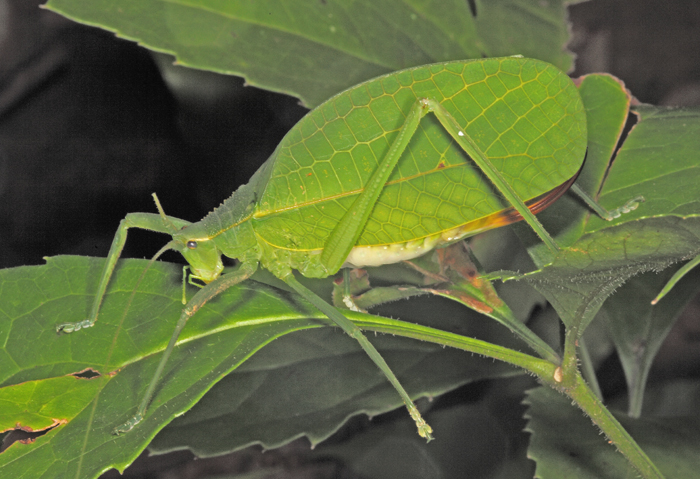
Mastigaphoides haffneri Weidner is a green katydid in a different subfamily from the above. It is a member of the Pseudophyllinae, a group with several rainforest genera that are often encountered at night.
Mating grasshoppers of the widespread oxyine species Methiola picta Sjostedt is common along rainforest margins in north Queensland where it feeds on a variety of grasses, native and introduced. 
One of several mantids living in the rainforest. This one is a species of Orthodera, at home on an introduced pine.

Just Guarding

 Our resident Amethystine Python spent some hours watching and waiting for something to show up along a drain during a recent storm. I was hoping he did not detect the Boyd's Forest Dragon sleeping on a branch not far from where he was.
The head shows an interesting pattern of scales.

Wednesday, 18 January 2012

What's Up!

A recent trip to Mt Baldy proved of interest to this python. I was busily photographing blattodeans along a forest track when I looked up and noticed that my movements had "activated" this snake which was lying in wait for some prey. As I moved the shrubbery, it became more and more alert to the cause. It looks pretty well fed.

Jaws!

Summer brings on longicornes, family Cerambycidae. Many of the larger ones have formidable mandibles that can easily open a severe wound. I am always impressed that these tough beetles never pose much of a challenge for the Black Butcherbirds that  actually hunt for them around the margins of the light sheet and adjacent vegetation. It would seem that they might at some stage get bitten, but I've never observed them have any problems during the dismemberment of the prey.
 
 The large jaws on these beetles are probably for cutting through dead wood on which they feed and in which the females lay eggs that will develop into the rather sizable larvae that will help to decompose the wood and return it to the soil. Each species seems to have slightly differently modified jaws. This probably reflects differences in how they use them.


A Bit Of A Mystery

For the past few years I have  been observing the strange antics of some peculiar "tube critters". These creatures, which appear to be caterpillars, start out by anchoring themselves to a particular spot on the bark of certain select trees. In this case, the Kuranda Quandong, Elaeocarpus bancroftii. As they develop, the case lengths to an ultimate length of about 80 mm. They operate in the radius dictated by their anchor and seem to be feeding on bark. After several months in the same spot, the surface of the tree does not seem to have changed in appearance at all. Selected trees bare 20 of these creatures within a couple of metres of the ground.

The case consists of phrass-bits and pieces of the bark and faecal matter. When Murray Upton visited last year we observed these creatures feeding an moving about on their tethers. At Thanksgiving we captured a few and kept them in humid containers but no adults eventuated. Now the tubes are disappearing, probably being broken up by the weather and ants which were seen around them months ago but that cause no harm. So we must wait till next year to attempt to see what these insects are. We think they are case moths, family Psychidae, but can't be certain until we see an adult.

The other mystery involves white creatures on this patch of lichen. Look carefully and you can see several elongate lumps!
 Each one has an amorphous shape. As a group, they "twitched" from time to time and they moved from place to place but for weeks stayed on the single patch of lichen. Other trees and patches were searched but no other sightings were recorded.
Then recently the group disappeared. I though the resident Boyd's Forest Dragon may have either eaten them or disturbed the group when he scuttled up the tree. Then one appeared on the light sheet in an apparent attempt to pupate. It is now in a container and we await the emergence of this odd insect.

They may be geometrid loopers that cover themselves with lichen. They inch along in the pattern of geometrid caterpillars but I've never heard of a geometrid that covers itself with its host plant.

Sunday, 15 January 2012

Some Good News

This morning we were greeted by the sight of two of the five chicks Mr Cassowary is shepherding this year. They are very small and not at all vocal. Judging by last year's events, they will require his full attention for the next several months.


Cute, eh

Friday, 13 January 2012

A Sad Tale


This is Mr Cassowary last year with one of his chicks. We recently heard that a visitor up the street witnessed a stray dog kill two of his three nearly full grown chicks. The dog had been sighted repeatedly out of its pen. When the owner was informed, he relocated the dog.

This is going to be the fate of these wonderful birds unless all dog owners become more responsible. Between the dangers posed by cars and the threat of stray or feral dogs, the poor cassowaries will be lucky to survive in the wild.