Translate

Wednesday, 3 April 2013

Birds! Birds!

My friend Peter Shanahan asked to share some of his bird photos with the readers of this blog. All are copyright and Peter should be consulted if they are sought to be used elsewhere.

A few are my own and I thought this the best place to display them. Most are common garden birds in north Queensland. Others can be found in open areas not far from the rainforest.

Peter Shanahan photo
The Bush Thick-knee or Bush Stone-curlew, Burhinus gralliarus, a most beloved bird. These birds can be found almost anywhere except in dense rainforests. They do occupy cleared areas along rainforest margins. They are most active at night and their eerie calls are startling to the uninitiated. They feed on insects and small invertebrates but obviously not on Cane Toads.

They often choose nest sites that are not conducive to the best end result. The often select parking lots, little-used roads and roadside verges to set up housekeeping. the nest is not much more than an gathering of a few twigs and leaves to form a cup. When the eggs hatch, the adults soon discover that they are not in the best place and carry on with the broken wing display and much hissing and and beak snapping. 
 This is not a dead chick but one that is playing "possum". This was photographed on a hot day and it remained in this position for several minutes causing some concern about its vitality. But later it was seen strolling with its parents.
 Double-striped Thick-knees, Burhinus bistriatus, in northern Costa Rica, 1972. The similarity in appearance and behaviur to the Australian species is striking.
 Bar-shouldered Dove. Geopelia humeralis  Photo by P.Shanahan © 2010
A gorgeous bird that is more often heard than seen. It seems to be a permanent resident in the rainforest.
 Emerald Ground Dove. Chalcophaps indica. Photo by P. Shanahan ©
Another beauty. This bird is at home on the ground as well as in the trees where it feeds on fruits. It is easily approached and must be the prey of snakes, goannas and hawks.
 Peaceful Dove  Geopelia placida. Photo by P. Shanahan ©
Most common in more open areas such as parks and large grassed areas. It is common and easily approached.
 Pied Imperial-Pigeon. Ducula bicolor. Photo by P. Shanahan ©
These large pigeons migrate between Australia and New Guinea each year. They are common in  street trees in Cairns and other coastal cities but they do not ascend the mountains to Kuranda.

Wompoo Fruit-Dove. Ptilinopus magnificus. Photo by P. Shanahan. ©
The Wompoo Fruit-dove is a very large bird that feeds on a varietu of tropical fruits and palm nuts. It is rather timid and is very difficult to approach. Peter was lucky to get this shot.
 Black-eared Cat Bird Ailuroedus crassirostris. Photo by P.Shanahan  © 
The common catbird in our area. The calls of this bird, usually at dawn in the morning are not unlike those of a wayward cat. It is a bowerbird but does not build a bower. It is an insect eater and is maligned because of its tendency to raid bird nests.
Tooth-billed Cat-bird Scenopoeetes dentirostris. P.Shanahan  © 
This is a different bird from the one above and is less often seen. It feeds on fruits and leaves of young trees. Males build a display court or stage that is decorated with leaves positioned with the undersides facing up. "Green" is the theme and leaves are replaced as they fade and age. The stage is placed near a tree buttress or root where the male can perch and wait for females. One attracted, the male bird goes through a series of dances that may eventually lead to a mating.
 Crested Lizard Hawk or Pacific Baza Aviceda subcristata Photo by P.Shanahan © 
This is one of the few birds I know that seeks out stick insects (Phasmatodea) as a food source. It also eats frogs and lizards. (It is a bit disconcerting to hear the sorrowful (Buck) cries from the frog victims of the bird as it dismembers them alive. When it spots a prey from the air, the bird has a characteristic diving behaviour that you would think could not work in the forest canopy, but the bird usually emerges with its quarry. 
 Boobook Owl  Ninox boobook Photo by P.Shanahan © 
This is Australia's smallest and most widely distributed owl. It is frequently heard at night in cities and we know of a residence in Canberra where one has returned to the same perhcing place year after year. 
Sooty Owl. Tyto tenebricosa.  Photo by P.Shanahan ©
This is a large, seldom-seen owl that feeds on possums, gliders, bandicoots, and birds to some extent. The call is an ear-piercing shriek.

Immature Ospreys  awaiting return of parents. Pandium haliaetus.  Photo by P.Shanahan. ©
I wouldn't call Ospreys a garden bird but they are found along the Barron River where they successfully nest and fledge young. 
 Black-necked Stork or Jabiru. Ephippiorhynchus asiaticus . Photo by P.Shanahan ©
Surely the Jabiru is not a garden bird but they are seen in open cane fields near Cairns and Mareeba. They are not common but impressive when seen at close range. They feed on a variety of vertebrates and invertebrates. What happens when they encounter a cane toad?
White-faced Heron Ardea novaehollandiae Photo by P.Shanahan ©
The Whiter-faced Heron is a garden bird depending upon the circumstances. If you have a fish pond, then surely you will have a visit, perhaps multiple visits. And the goldfish will disappear and those that escape the heron will probably be enjoyed by the Keel-backed Snake!
Pacific Black Duck. Anas superciliosa. Photo by P.Shanahan © 
The Pacific Black Duck is the Australian equivalent of the Mallard. Steps have been taken to keep Mallards under control in Australia because they have the tendency to interbreed with others in the genus and produce hybrids. Black Ducks are common visitors to park ponds and garden ponds if out in the open and of large size.
 Magpie Goose. Anseranas semipalmata. Photo by P.Shanahan 2010 ©
Flocks of Magpie Geese are being seen now in the open grasslands and lakes around Mareeba. Why is black and white such a common theme amongst Australian birds?
Magpie Geese. Anseranas semipalmata at Freshwater  lake. Photo by P.Shanahan 2010 © 
Radjah Shelduck or Burdekin Duck. Tadorna radjah. Photo by PShanahan  ©
This is a coastal or Mangrove duck. If you are lucky you can see them in the lakes of the Cairns Botanic Gardens adjacent to Greenslopes St. These ducks feed on crustaceans and plant material in their habitat. They nest in tree holes or hollows in branches.
Orange-footed Scrubfowl. Megapodius reinwardt. Photo by P.Shanahan. ©
The mortal foe of every gardener is the Orange-footed Scrubfowl (along with the Brush Turkey). The raking habits of these birds and the persistence they display in getting their way, makes gardening a real challenge in the northern tropics. Placing chicken wire on the ground and covering with leaf litter can discourage their scraping. Scrub fowls are megapodes and build large mounds into which they lay their eggs. Some mounds can be many metres in height and length and are the efforts of birds over several generations.
Sulphur-crested Cockatoo. Cacatua galerita.  Photo by P.Shanahan © 
Coming from the southern temperate climes of Canberra, I had no idea that cockatoos would be so common in the rainforest. They are important feeders because the rubble they leave behind is eaten by a variety of other organisms.

Helmeted Friarbird Philemon buceroides. Photo by P.Shanahan ©  
The "bully-boy" of the bird feeder. There is much beak-snapping when these birds show up at the feeder. They are Honeyeaters, albeit very large ones. They eat a lot of insects that they encounter when feeding on flowers. Scarabs seems to be a favourite food. 
Noisy Pitta Pitta versicolor  Photo by P.Shanahan ©
This bird is more often heard than seen. It is a rainforest birds and Peter was lucky to find one in the open when he had his camera available. Pittas feed on worms and insects they find on the rainforest floor in the leaf litter they seem to endlessly search. This species extends north to New Guinea and Indonesia. They use certain rocks as anvils to crack open snails. If lucky, you can find such a favoured rock and the shells of the snails scattered about.
 Spangled Drongo Dicrurus bracteatus. Photo by P.Shanahan Nov 2011  ©
This is a seasonal bird that is often in small flocks. The birds are very vocal and the calls travel for a considerable distance. "Drongo" is an Aussie slang word for an idiot. This refers to the behaviour of the bird which is at best erratic. Drongos feed on insects, small birds and skinks. 
 Mrs Cassowary
Cassowaries are garden birds in our neighbourhood.
Red-browed Finches bathing in rain puddle. Noechmia temporalis. Photo by P.Shanahan © 
What more can I say!


Tuesday, 19 March 2013

What's In A Name?


Most people who deal with scientific names (Latin or Latinised words) have some knowledge of what they mean. Generic names can be meaningful or fanciful. It is all in the hands of the describer. As long as the name has not been used before (is pre-occupied) and is not derisive or needlessly obscene, most editors will accept an author’s choice.

Not all authors provide readers with the derivation of their names.
Francis Walker named hundreds of genera and species in many groups of insects. In fact he was paid on the basis of the number of species he named. But that’s a different story. He seldom provided any information on the basis for his generic names. Examples are Dexerra Walker 1869 and Requena Walker 1869 of his genera that were named without a hint of what, if anything, they meant. Both are Australian katydids. Later Ander in 1938 described another katydid and called it Xederra without explanation. I assume it is an anagram of Dexerra. The two are only distantly related.

I preparing the cockroach guidebook for CSIRO publications, I was met by a number of unusual generic names. I know what they meant but would be certain that most readers would not have a clue. Examples are Hensaussurea, Beybienkoa, Carbrunneria, Johnrehnia and Eowilsonia. You can get a hint from the last two. They are all generic names composed by combining the first and last names of the persons to be so honoured. [And yes, it would be an honour to have a cockroach genus named for you!]

Here are some notes on the origins of the above names. This may add some interest to discovering the richness of the Australian fauna.

Karl Princis, the Swedish entomologist, was the first of the modern taxonomists to combine Christian and surnames into one latinised word. Louis Roth, the most recent perpetrator, continued the trend with a few of his own.

Hensaussurea Princis 1954 (contains 11 Australian species)
Hensaussurea sheardi Roth                                      D. Knowles photo

Named for Henri Louis Frederic de Saussure a distinguished Swiss entomologist who was skilled in unrelated fields such as geography and mineralogy. He founded the Geographical Society of Geneva but spent most of his time at the Natural History Museum of Geneva.
Henri Louis Frederic de Saussure


Carbrunneria Princis (13 Australian species)

Carbunneria marci Roth

Named in honour of Karl Friedrich Brunner von Wattenwyl (1823-1914) was a Swiss entomologist. He was director of the telegraph office in Vienna but was mostly interested in entomology. He published many important works in the field of orthopterology. He was also Professor of Physics at University of Bern, 1850-55.
Karl Friedrich Brunner von Wattenwyl


Johnrehnia Roth (36 Australian species)

Johnrehnia concisa (Walker)

Named in honour of John William Holman Rehn was the son of James A. G. Rehn, Curator of Orthoptera at the Academy of Natural Sciences of Philadelphia. He took up an interest in Entomology and published several papers on the higher classification of the cockroaches that were based on their wing venation. He spent his career in the US Army.
 John W. H. Rehn

Beybienkoa Roth (23 Australian and New Guinea species)

Beibienkoa kurandanensis Roth

Named in honour of Grigory Yakoveivich Bey-Bienko (1903-1971) a Russian entomologist of considerable note. He studied many groups of orthopteroid insects and had several genera and many species named in his honour. Prof Bey-Bienko was the Stalin Prize winner in 1952 in honour of his international recognition as an entomologist.
Grigory Yakoveivich Bey-Bienko


Eowilsonia Roth (3 Australian species)

Eowilsonia biglandulifera Roth 

Named for Edward O. Wilson (1929-) the noted biologist, conservationist and entomologist specialising in the study of ants. He is known and the “Father of Sociobiology” for his books depicting the biology and behaviour of ants. He is Professor Emeritus at Harvard University where Louis Roth, the author of the genus, worked for many years in retirement. 

Prof. Edward O. Wilson from the web

Francis Walker (1809-1864)

Paratemnopteryx centralensis (Roth)

The much maligned Francis Walker. The cockroach genus Franwalkeria Princis is named in his honour. Ironically, it is now a synonym of Paratemnopteryx!

Friday, 15 March 2013

Night Wanderings

It has been an unusually dry wet season in the far north of Queensland. To the south it is a different story with record rains and floods in south Queensland and northern New South Wales. The February rainfall averages from 100-600 mm in Kuranda. This year we received 114 mm.

The insects have been patch at best but here are a few examples from recent forays into the local bush.

The Tinaroo Road near Mareeba offers a number of different habitats ranging from wet eucalypt-acacia woodland to rather dry, sparsely vegetated mixed woodland. Along the creeks, there is gallery forest and natural grassland---where it has not been devastated by grazing and burning.


 Antlions are frequent visitors to the lights, especially in mixed woodlands.
 This caterpillar was found on the tip of a Causarina needle
 This Brown Tree Snake, Boiga irregularis, stopped by. It positioned itself on a shrub near the light-sheet and remained there for about 10 minutes after sizing up the situation and deciding there was not much use in hanging around. It is a rear-fanged colubrid snake that feeds on birds, lizards, bats and small mammals. A large example is 2 m but most snakes are much smaller than that.
 The Brown Tree Snake is often called the Night Tiger because of its striped pattern. It is responsible for devastating the bird population of Guam due to its inadvertent introduction there.
 The Snake Mantid, Kongobatha diademata Hebard, waiting to ambush passing prey.
A March Fly. This year they are actually active in March. Females bite ferociously but males like this one lack the mouthparts to provide a blood meal. They feed on nectar and often come to lights suggesting they are nocturnal. Females bite during the day and almost never are seen around lights. Males have large eyes that meet on the top of the head. We have dealt wit this aspect of their life history before.
A pair of mating long-horned beetles. This species seems to be associated with grasses.
 Late afternoon is a good time to photograph diurnal grasshoppers as the ambient temperature winds down and they decrease their activity. This a male of what appears to be Cedarinia costata Sjøstedt. The dorsal stripe is generally atypical of this species.
 Cedarinia costata Sjøstedt, female.
 Caledia captiva (Walker): Acrididae; Acridinae; Acridini is a grassland species commonly found along forest margins or at the edges of walking tracks. The white band near the tip of the hind femur is distinctive of this grasshopper. It is distributed along the east coast of Australia and into the tropics and in the coastal areas of the Top End, that is northern Northern Territory and northern Western Australia. It's genetics have been studied in the past by Dr Dave Shaw and his colleagues at the Australian National University.
The Black-faced Theomolpus, Theomolpus pulcher (Sjøstedt); Acrididae; Catantopinae; Macrotonina is aptly named. It has a rather limited distribution in the tropics south of the Daintree Region. There is one other species in the genus known from Cooktown.
Adult male Black-faced Theomolpus, Theomolpus pulcher (Sjøstedt); Acrididae; Catantopinae; Macrotonina.
 A matchstick grasshopper, Morabidae; Morabinae (formerly family Eumastacidae) at night on Casuarina needle. These grasshoppers appear to be nocturnal.
 Grass-straddler, Rhachidorus longipennis Rentz: Tettigoniidae; Tettigoniinae;  Nedubini uses its long legs to position and steady itself in tall grasses where it feeds on pollen and seeds at night. The tarsi of the hind legs are elongated to help it grasp the stems. This genus, and several others in Australia, is distantly related to those in both southern Africa and the Pacific northwest of North America.
 Caedicia sp.: Tettigoniidae; Phaneropterinae probably pictipes StÃ¥l abroad after dark.
  Caedicia sp.: Tettigoniidae; Phaneropterinae probably pictipes StÃ¥l, a last instar nymph with banded hind tibiae.
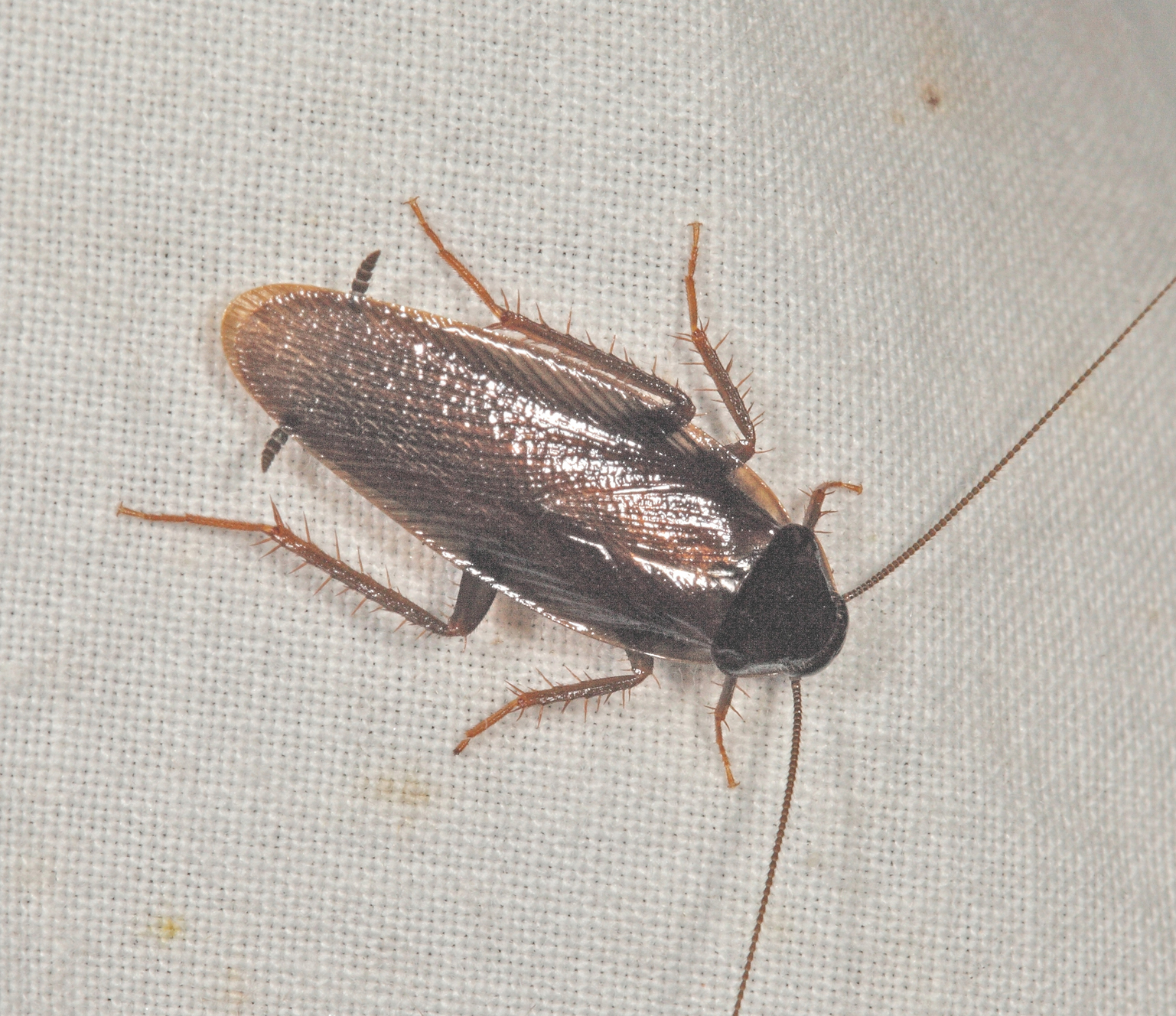
Male Johnrehnia sp.: Ectobiidae; Blattellinae feeding on eucalypt trunk. Females of this species are black. This was one of three Johnrehnia species found a this site. Nothing is known of their activities. Some species of the genus are commonly found in leaf litter but the activity patterns, ecological requirements and and feeding habits of most blattellines are largely unstudied in Australia.

Wednesday, 6 February 2013

Night Tigers

Growing up in northern California and collecting beetles as a boy I always took the challenge to chase the fast-moving and visually acute Tiger Beetles (family Carabidae, subfamily Cicindelinae). But it always seemed that the species was the same, Cicindela oregonensis, whether we were collecting along the coast or along mountain streams in the Sierra. Rarely, one could find a real treasure, the large black Tiger Beetle, Omus. These beetles live in a different habitat--under bark, and prophetically, under the bark of downed eucalyptus trees where you usually encountered very little-- Sow Bugs (crustaceans) or certain tenebrionids. But I digress.

In Australia we see Tiger Beetles at the light sheet every night during the summer season and they can be spotted during the day where they actively pursue small insect prey. I have noted this before in this blog.  I often see these beetles on tree trunks in the rainforest facing head downwards awaiting unsuspecting insect meals during the day. Recently at a site in a mixed eucalypt-acacia forest along the Clohesy River we found two species of the genus Dystipsidera. When spotted during the day on tree trunks, these beetles are alert and very difficult to approach. With their propensity to be attracted to lights,  I had thought that they might be nocturnal. They are known for their extraordinary eyesight and could potentially see on bright, moonlit nights.

Two species were spotted sitting on leaves or grasses and they seemed to be active. But they were within 15m of the light sheet and that could have prompted their movements.
 Dystipsidera flavipes is the larger of the two species and lacks the brown markings of its relative.
Dystipsidera sericea is the smaller of the two and seems to be less common.

Cicindela sp probably semicincta, is a widespread, Cosmopolitan genus of Tiger Beetle. Here is devours an ant that has come to light. The larva of these beetles construct vertical subterranean burrows and protrude their heads with the massive jaws that seize any unsuspecting passing insect. As note, members of this genus seem to be found not far from waterways.

Always something of interest in this great country.

Saturday, 2 February 2013

It's Been A Good Year--For Some Things

Monteith's Leaf Insect, Phyllium monteithi Brock and Hasenpusch

I have reported on this insect several times in this blog. It is the only known Australian representative of the widespread genus. Usually I see a couple of males at the light sheet but this year four have appeared. It has been an oddly dry wet season this year. The female of the species is extremely elusive. Only one has been found in nature. Reasons for their rarity seem simple. They rarely, if ever, fly and they are truly arboreal. When the males show up at the lights, they tend to move upwards towards the canopy. I suspect that's where the girls are too.
 The flanged legs add to the leaf allusion.
 The three spots on the top of the head are "ocelli", false eyes, the function of which is rather speculative.
A peculiarity of this species is the "fuzzy" antennae.